

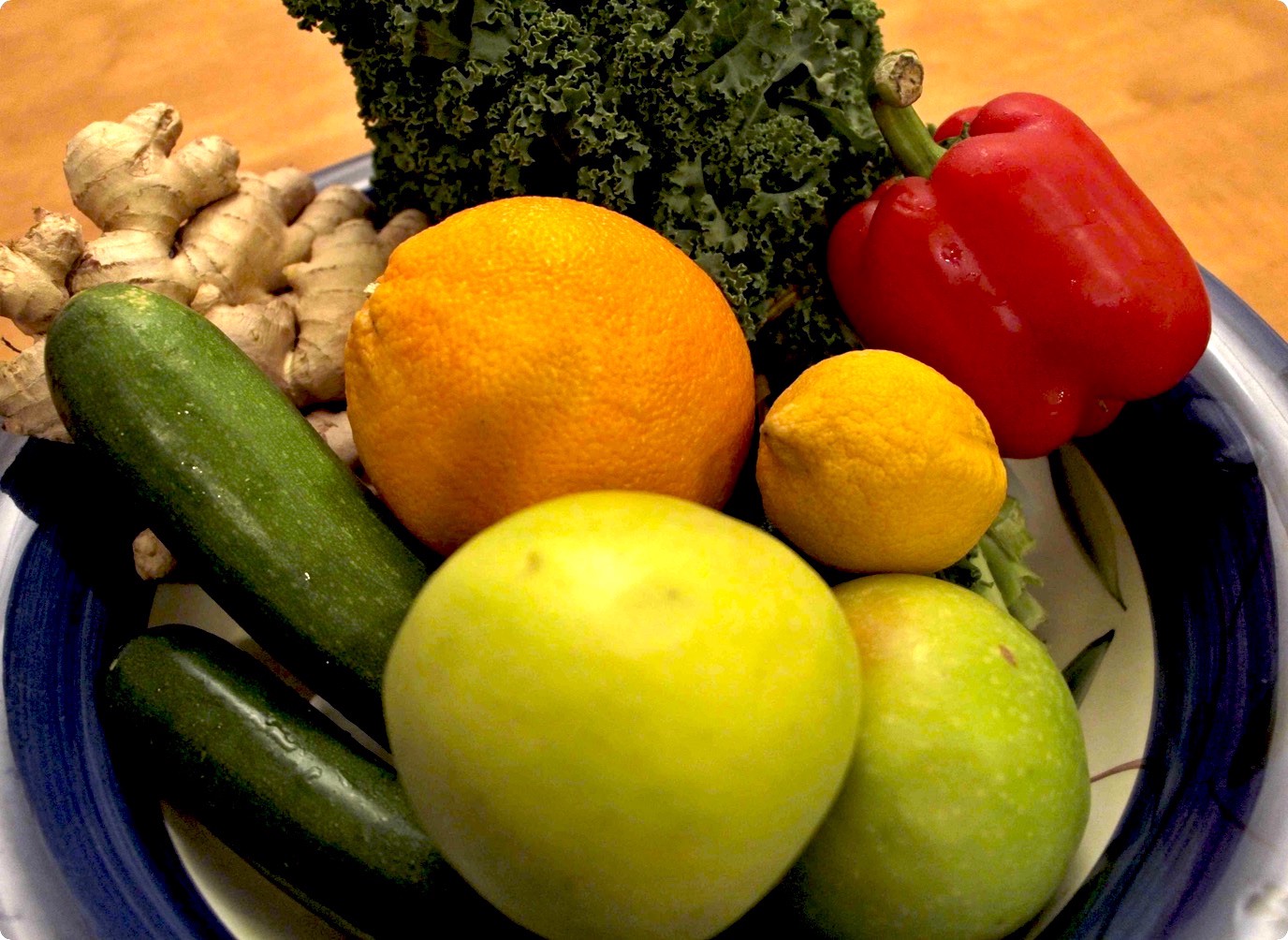
One of the funnest things to do is to get up early, cut some of my pre-washed, clean vegetables and fruits, and put them through the juicer. Vegetables and fruits make up for a delicious, refreshing juice. Done every morning, you will definitely keep yourself looking and feeling healthy. At first it can be overwhelming, because there is so much freshness. Once you get in the habit of doing it, you wonder how you did without it. A sense of vitality and improved energy helps you through the day.
TYPES OF JUICER
First, we will discuss the types of juicer so you can decide which one is right for you. In my case, I have two types: a heavy-duty for my daily morning jolt, and a quick and easy for a juice-fix any time during the day. There are three types of juicer:
Centrifugal
Masticating
Triturating
Centrifugal
Centrifugal Juicers are the most popular and most affordable type of juicer. They get the job done, but do not extract high-yields from grassy and leafy foods like wheatgrass, spinach, or parsley. Centrifugal juicers first grate the fruit or vegetable into a pulp and then uses centrifugal force to push the pulp against a strainer screen by spinning it at a high RPM. The higher the RPM’s the higher loss of enzymes. There are newer centrifugal juicers spinning at lower RPM’s nowadays called extractors, that are better at keeping the enzymes, but do not produce as high as a quantity.
Masticating
There are two types of Masticating Juicers. Single gear and upright. These are generally more efficient than Centrifugal juicers because they can extract more concentrated juice. Masticating juicers are also more versatile because not only it extracts the juice but it also homogenize food to make baby foods, nut pastes, frozen banana ice-cream and fruit sorbets. The newer masticating juicers, especially the twin-gear, are great at extracting juice from leaves and grasses.
Triturating
These twin-gear juicers are usually the most expensive, but offer the most benefits. They will yield the highest amounts of fresh juice from fruits, vegetables and leaves. The pulp that comes out of these triturating juicers is the driest of all the other types. They are a combination of a standard juicer and a wheat-grass only juicer. The high-squeezing force of the twin gears breaks open tough cell walls and releases more enzymes, vitamins and trace minerals.
As I said, I have two kinds: a masticating and a newer centrifugal that is being called extractor.
BENEFITS OF JUICING
It cannot be understated how our bodies, especially our cells, crave fresh minerals, vitamins and enzymes. Research keeps revealing that diet and disease are interrelated. Poor diet, poor health. Rich-in-nutrients diet, rich health. Many of us have lived on a poor diet: fried and processed foods, soda, bottled fruit juices, canned vegetables, and a plethora of harmful ingredients that have been introduced into modern-day diet. Returning to fresh and wholesome eating will definitely produce benefits, but add juicing and you have just exponentially accelerated the process of nourishing your body and your mind back to a state of rich health. If 95% of the vitamins and enzymes our bodies require are found in the extracted juice of raw fruits and vegetables, then I’d say there are many benefits of juicing. Here is a quick list:
Concentrated intake of vitamins, minerals and enzymes are absorbed by the bloodstream
Digestive organs get a special rest because all of the nutrients go straight to the blood
Weight loss
Increased energy levels
Strengthened immunity
Strong bones
Glowing complexion
You get the gist. There are enormous benefits. Now, of course juicing without good sleep, moderate exercising, healthy nutrition and positive emotions will not fully do the trick, but it is a great start and will get you on the right track.
Two more tips regarding juicing:
Buy organic. Why? Because conventional produce is filled with fertilizer toxins. Besides vitamins, enzymes, and minerals, your bloodstream will also absorb chemicals and pesticides. If organic is too expensive then consider planting a garden. Look for an upcoming gardening section.
Use a glass jar. Why? Most plastic cups contain BPA (Bisphenol-A), an industrial chemical found in plastic and resins, and research has shown that BPA particles can be released into food or beverage. The adverse effects are manifested in the brain, behavior and prostate gland. To know more, the FDA has produced detailed research on children’s exposure to BPA:
http://www.fda.gov/%20newsevents/publichealthfocus/ucm064437.htm
JUICE RECIPES
There are a variety of ways to juice, and the web is filled with recipes. I am going to give you a few of my favorites:
Green Power
1 cucumber
2 leaves of kale or colored greens
2 stalks of celery
1 cucumber
1 peeled lime
1 green apple
1 piece of ginger (thumb size)
8 leaves of mint
Red Power
1 carrot
1 beet
1 peeled lime
1 piece of ginger (thumb size)
1/2 bunch of parsley
Yellow Power
2 peeled oranges
1 peeled lime
1 piece of ginger (thumb size)
1 piece of turmeric (thumb size)
1 cup of pineapple cubes
3 leaves of yellow chard
WASHING YOUR PRODUCE
In order to remove pesticides and bacteria from my vegetables and fruits, I wash them as soon as I either get them from a local grocer or pick them from my garden. In order to remove parasites or potential bacteria, here is a recommended treatment for vegetables, greens and fruits:
If you have a double sink, fill up one sink, or for those with a single sink, fill up a large bowl with tap water and half a cup of vegetable wash. Vegetable wash is available in most grocery stores. However, if you do not trust what is being sold out there, you can use one cup of white vinegar. It is much cheaper and it does the trick.
Fill up one large bowl with filtered water and 4 tbs of diluted food-grade hydrogen peroxide. Food grade hydrogen peroxide can be purchased online or at boutique health-food stores. IMPORTANT: prior to using, dilute the food-grade hydrogen peroxide at the ratio of 11 to 1. I usually put one part of hydrogen peroxide and ten parts of filtered or distilled water in a canning glass jar and keep the jar in the refrigerator. Always use the diluted and not the concentrated hydrogen peroxide
Wash the individual vegetables or fruits in the tap-water solution
Rinse them in running tap water, and then soak them in the filtered water / hydrogen-peroxide solution for two to three minutes
Dry with a clean towel; if greens, use a salad spinner to dry faster
Bag using non-BPA plastic bags, and mark the date with a permanent marker.