


Most of us prepare food on autopilot.
We rinse produce quickly, move from cutting board to plate, and focus on the end result: the meal itself. It’s efficient, and often necessary. But in that efficiency, something subtle is lost—the awareness that preparation is not just a step before eating. It is part of the act of nourishment itself.
Long before flavor or nutrition comes into play, there is handling, cleaning, and care. These small actions, repeated daily, shape both the quality of what we eat and the relationship we have with it.
A Quiet Step We Often Overlook
This early moment in the process rarely draws attention.
It happens quickly, almost unconsciously, and yet it sets the tone for everything that follows. The way we handle our food—whether rushed or intentional—carries through to the experience of eating itself.
In a culture that often emphasizes what to eat, it is easy to overlook how we prepare it. But the two are more connected than they seem.
Why Washing Fruits and Vegetables Matter
Fresh produce passes through many environments before reaching the kitchen. From cultivation and harvesting to transport and storage, fruits and vegetables are exposed to soil, handling, and, in some cases, residual substances used to protect crops.
Washing is not about achieving sterility, nor is it about fear. It is a simple, practical way to reduce what doesn’t need to be consumed and to bring a level of attention to what does.
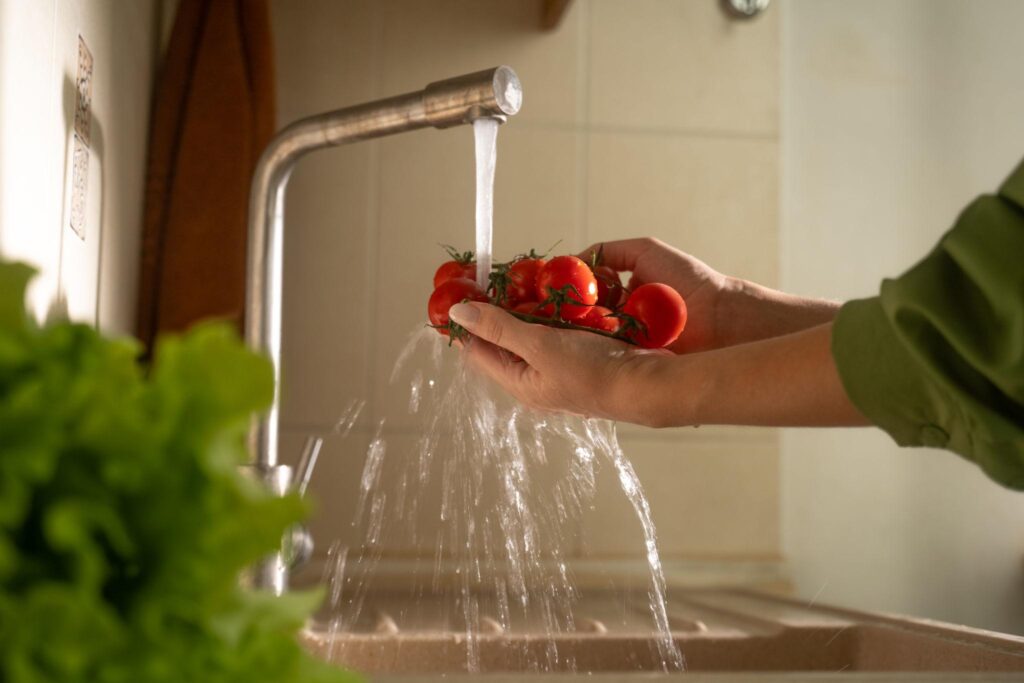
According to the U.S. Food and Drug Administration, rinsing produce under running water helps remove dirt, bacteria, and traces of pesticides from the surface.¹ While no method eliminates everything completely, consistent washing significantly reduces exposure in everyday eating.
In this sense, washing is less about perfection and more about intention—an acknowledgment that what we eat deserves a moment of care.
A Practical Approach to Washing Produce
For most fruits and vegetables, a straightforward approach is enough.
Running water, combined with gentle friction from your hands, effectively removes surface residue. Firm produce such as apples, cucumbers, or carrots can benefit from a soft brush, while more delicate items—like berries or leafy greens—require a lighter touch.
Leafy vegetables are best rinsed with the leaves separated, allowing water to reach areas where dirt can collect. Berries, on the other hand, should be washed just before consumption to prevent excess moisture from accelerating spoilage.
Washing fruits and vegetables does meaningfully reduce what doesn’t need to be consumed. Running water, combined with gentle friction, helps remove dirt, bacteria, and, in some cases, traces of residues from the surface.
More involved methods—such as soaking in vinegar or baking soda—can offer additional benefits in specific situations, but they are not essential for everyday practice. What matters most is consistency: a simple habit, repeated daily, that supports both cleanliness and awareness, without making your produce sterile.
Some people choose to soak produce briefly in a solution of water with vinegar or baking soda. While this can help remove certain residues more thoroughly, it is not essential for everyday practice. Simplicity, when done consistently, is often more effective than complexity applied occasionally.
Common Mistakes to Avoid
In an effort to do things “properly,” it is easy to overcorrect.
One of the most common mistakes is washing produce too far in advance. Moisture left on fruits and vegetables can encourage faster spoilage, reducing both freshness and shelf life.
Another is applying the same method to everything. Different foods require different handling, and a one-size-fits-all approach can either be ineffective or unnecessarily harsh.
Finally, there is a tendency to overcomplicate the process—adding multiple steps, products, or techniques that offer minimal additional benefit. In most cases, consistency with simple methods is more valuable than occasional perfection.
A Broader Way to Think About Food Preparation
Health is often framed in terms of what we eat—nutrients, ingredients, and dietary patterns. But equally important is how we engage with food before it reaches the plate.
Preparation is one of the few moments where intention can be reintroduced into an otherwise automatic routine. It is not dramatic or visible, and it does not require extra time. Yet it subtly shifts the experience of eating from passive consumption to active care.
Over time, these small acts accumulate. Not as rigid rules, but as quiet habits that support well-being in a steady, sustainable way.
Because in the end, health is rarely built through extremes. It is shaped in the ordinary moments we repeat every day—often without noticing.
References
- U.S. Food and Drug Administration. Safe Handling of Fruits and Vegetables.
- Centers for Disease Control and Prevention. Food Safety: Fruits and Vegetables.
- U.S. Department of Agriculture. Washing Produce.