


The Lost Art of Living Well
What if habits that help human beings remain well are deeply ordinary?
There is a peculiar exhaustion that seems to define modern life.
Not the satisfying kind that arrives after meaningful work, a long walk home, or a dinner that stretches late into the evening with people you love. A quieter exhaustion. The kind created by constant acceleration. Endless notifications. Permanent urgency. The subtle feeling that life is always happening one step ahead of where we currently are.
We monitor our sleep while sleeping less. We consume wellness content while eating lunch at our desks. We purchase supplements, productivity tools, ergonomic furniture, and health trackers, hoping they might somehow compensate for the growing sense that many of us feel disconnected from our own lives.
And still, despite all our advances, many people remain physically depleted, emotionally overstimulated, and strangely lonely.
Which raises a couple of uncomfortable questions: what if health was never meant to be pursued primarily through optimization? What if many of the habits that help human beings remain emotionally and physically well are not revolutionary at all, but deeply ordinary?
An Ancient Saying by a Wise Grandmother
As our Brazilian grandmother used to say:
“Quem não anda, desanda.”
Roughly translated, it means: those who stop moving slowly fall apart.
There is an entire philosophy of health hidden inside that simple sentence.
Researchers have spent decades studying regions of the world where people tend to live remarkably long lives with lower rates of chronic disease. These communities—often referred to as “Blue Zones”—include places like Okinawa in Japan, Sardinia in Italy, Ikaria in Greece, Nicoya in Costa Rica, and Loma Linda in California. While some longevity claims surrounding Blue Zones have been debated over the years, researchers continue to notice recurring patterns in the lives of many people who live there: natural movement, strong social connection, slower daily rhythms, time outdoors, shared meals, and a sustained sense of purpose.
What is most fascinating is not that these communities discovered some hidden secret. It is that they never fully abandoned certain human fundamentals in the first place.
The people who move all day rarely think of it as exercise
One of the most consistent observations in longevity research is surprisingly simple: people who remain active throughout life often move gently and continuously, rather than intensely and occasionally.
Their movement is woven into daily living.
They walk to visit neighbors. They cook. They garden. They clean. They carry groceries. They spend less time sitting for extended periods. Physical activity is not isolated into a single hour at the gym before returning to ten or twelve sedentary hours indoors. Instead, movement quietly exists throughout the structure of the day itself.
Modern wellness culture often treats movement as performance. We measure it, optimize it, monetize it, and compare ourselves against one another. Exercise becomes another category in a life already crowded with metrics and expectations.
Walking, however, still remains one of the most restorative forms of movement available to human beings.
A Human Pace
Research continues to associate regular walking with improved cardiovascular health, stress reduction, better sleep, improved mood, and healthier aging overall. Yet walking seems to offer something beyond physical benefit alone. It restores a pace the nervous system can actually tolerate.
There is something psychologically calming about moving slowly enough to notice life again. The changing color of the sky before evening. The smell of rain on pavement. Wind moving through trees. A neighbor watering flowers. Birds arguing somewhere in the distance.
Many people rarely experience these moments anymore—not because they do not care about beauty, but because modern life increasingly removes the conditions under which these experiences naturally occur.
The body was never designed for permanent indoor living
Public health researchers have increasingly explored the idea of what some now call “lonelygenic environments”—spaces dominated by noise, concrete, traffic, isolation, and limited access to nature or communal gathering places.
The term itself may be modern, but the underlying reality is not.
Human beings evolved in relationship with sunlight, weather, water, seasons, trees, soil, and one another. Yet many people now spend most of their lives moving between climate-controlled rectangles: homes, offices, cars, stores, screens.
Even when we barely notice it consciously, the body still responds to this absence.
A walk through a park is not merely exercise. Eating outdoors is not merely aesthetic. Gardening is not merely decorative. These experiences reintroduce forms of sensory input that the human organism has historically associated with regulation and stability: natural light, wind, texture, birdsong, open space, unscripted interaction.
Not rejection of the modern world, but balance within it
Modern life has made convenience remarkably abundant while simultaneously reducing many of the subtle conditions under which human beings historically remained emotionally grounded.
None of this means modern technology is inherently harmful, nor does it diminish the very real connections many people now build through digital life. Entire friendships, support systems, creative collaborations, and communities now exist across screens and across countries in ways previous generations could hardly imagine.
Video calls allow grandparents to see grandchildren oceans away. Instant messaging keeps relationships alive across time zones. Many people perform meaningful work through computers every day, and even communities centered around wellness, creativity, and emotional support now flourish partly online.
The goal is not rejection of the modern world, but balance within it.
Human beings may thrive best not by abandoning technology altogether, but by remembering that beyond our screens exists a living world still capable of restoring us through movement, sunlight, conversation, nature, beauty, and presence.
We do live in a beautiful world.
Sometimes health begins simply by re-entering it, little by little.
The healthiest communities are rarely built around individualism
Another pattern appears repeatedly across longevity research: strong social connection.
Not audience-building. Not online visibility. Not networking.
Real connection.
Shared meals. Multi-generational relationships. Neighbors who know one another. Communities where people remain useful to others throughout life.
Researchers studying Okinawa have long observed the role of social support networks—known as moai—in helping sustain emotional and practical support over decades of life. In many ways, these relationships function less like occasional friendships and more like long-term social ecosystems.
This can be difficult to replicate in modern culture because contemporary life often rewards independence above interdependence. Many people now spend enormous portions of life physically alone while simultaneously overstimulated by constant digital communication. The result is a strange paradox: permanent contact paired with chronic disconnection.
And yet human beings still seem to crave the same ancient things they always have.
To feel recognized.
To feel included.
To feel remembered.
To feel useful to someone else.
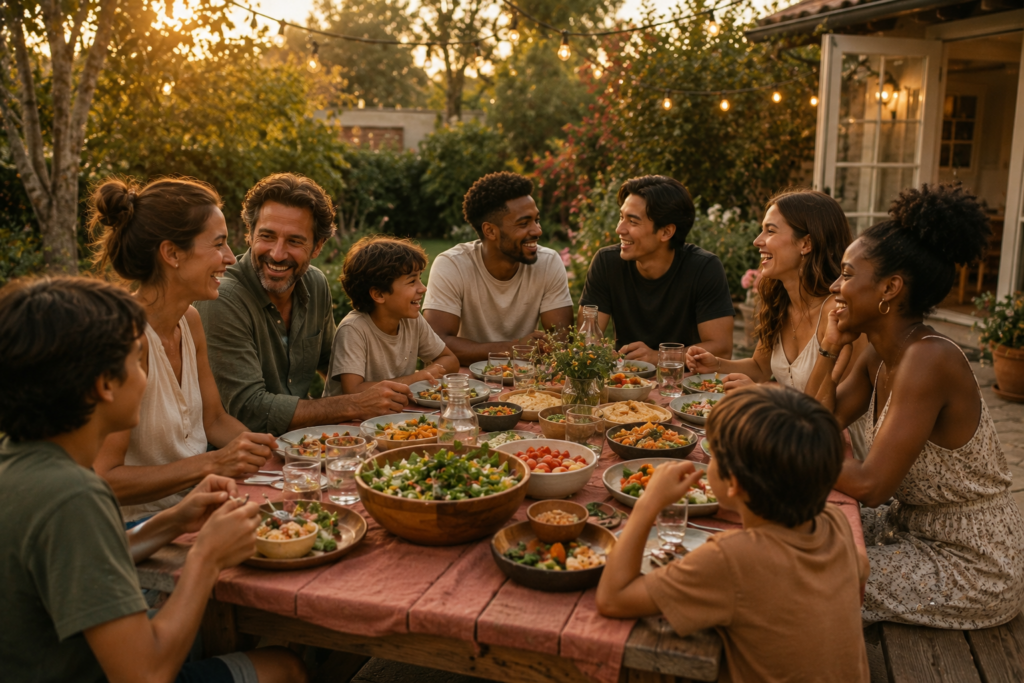
Perhaps this explains why some of the healthiest moments in life rarely look particularly productive from the outside. A slow dinner with friends. Coffee shared on a porch. A recurring morning walk with a parent. A phone call that lasts longer than necessary. A backyard table filled with conversation and food.
These moments often appear insignificant while they are happening.
Over time, however, they may quietly become part of the architecture of health itself.

Maybe wellness was never supposed to feel frantic
There is a subtle irony embedded within much of modern health culture: many people now pursue wellness in ways that increase stress.
More tracking. More rules. More comparison. More pressure. More guilt over not doing enough correctly.
Yet many long-lived cultures seem to approach health less as a personal performance project and more as a rhythm woven naturally into everyday life.
Meals are slower. Rest is normalized. Movement happens organically. Relationships remain integrated into daily routines. Purpose is not postponed until retirement, but carried quietly throughout life itself.
Researchers studying Blue Zones have repeatedly identified a sense of purpose as one of the recurring characteristics associated with healthier aging. In Okinawa, the concept of ikigai loosely translates to “reason for being” or “the reason you wake up in the morning.”
That idea may matter more than we realize.
Because human beings do not thrive merely from avoiding illness.
They thrive from remaining emotionally inhabited by their own lives.
From having reasons to wake up. Reasons to contribute. Reasons to gather. Reasons to care.
Perhaps that is the deeper lesson hidden beneath all the studies, supplements, wellness trends, and longevity debates: the healthiest life may not always be the most optimized one. Sometimes it is simply the one that still feels inhabited.
References
- Blue Zones — Okinawa, Japan
https://www.bluezones.com/exploration/okinawa-japan/ - National Center for Biotechnology Information (NCBI) — Longevity and Blue Zones
https://pmc.ncbi.nlm.nih.gov/articles/PMC6125071/ - Harvard Study of Adult Development
https://adultdevelopmentstudy.org/ - Walking and Health Benefits
https://www.prevention.com/fitness/a71201296/major-benefits-from-walking-every-day/ - Nature, Loneliness, and Human Well-Being
https://www.washingtonpost.com/wellness/2025/06/17/nature-reduces-loneliness/
Suggested Internal Link:
- “How You Prepare Your Food Matters More Than You Think”
https://livinghealth.tv/how-you-prepare-your-food-matters-more-than-you-think/